





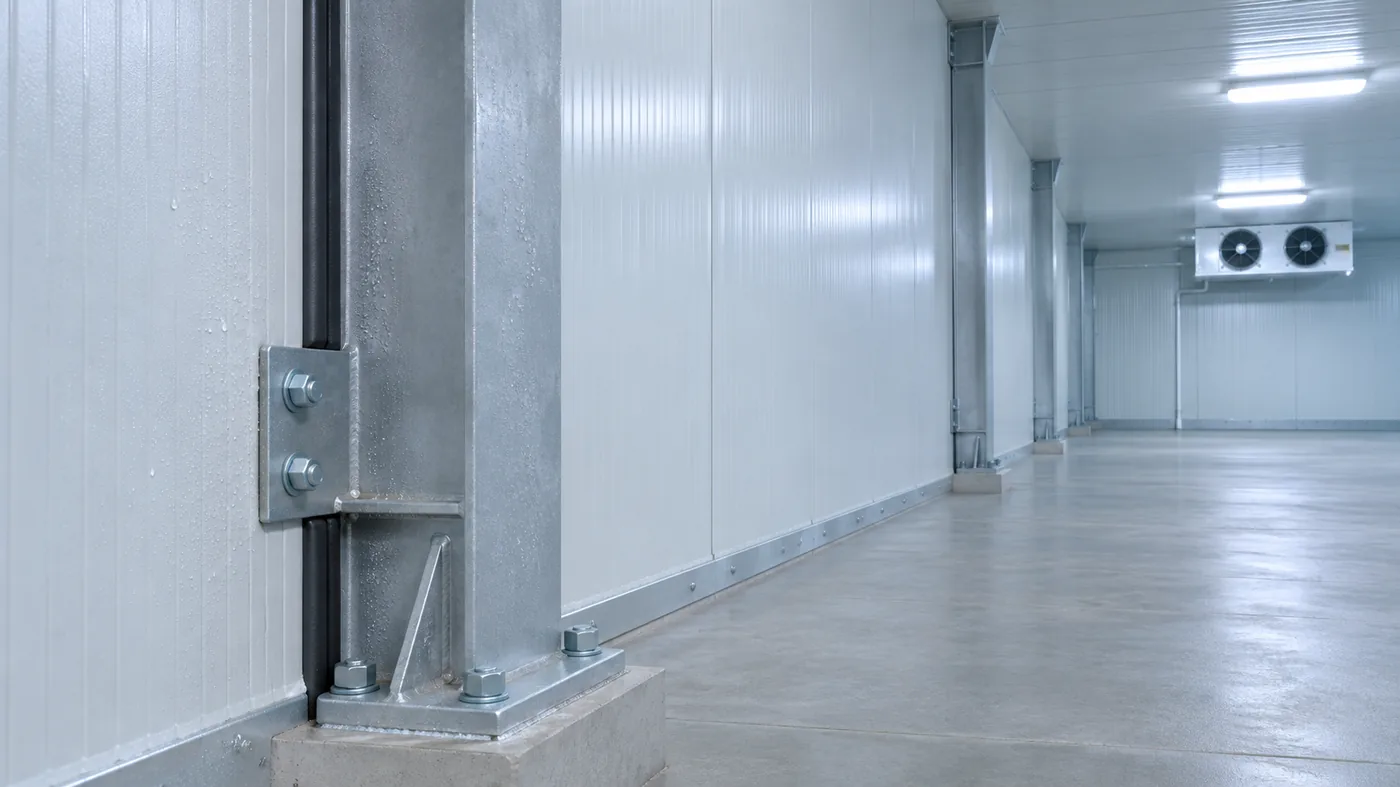
Cold-store maintenance is often treated as a structural inspection. In practice, most early warning signs appear in the envelope: damaged panel joints, failed seals, ice at doors, condensation on cold surfaces or water on the floor. Those signs should trigger an investigation before corrosion reaches the frame.
Routine checks that staff can do
People working around docks and cold-room doors notice changes first. A torn seal, a new patch of ice, a door that no longer closes cleanly or water appearing during a defrost cycle are useful early indicators. A simple log of those observations gives the maintenance team a head start.
Panel joints and seals
Inspect panel joints, corner details, door frames and penetrations for gaps, damaged tapes or compressed gaskets. Ice or frost at a joint suggests warm moist air is reaching a cold surface. Repairing the seal early is much cheaper than replacing wet insulation.
The frame behind the envelope
Where access allows, check the steel for coating damage, rust staining or moisture. Pay attention to connections that cross the thermal envelope and to areas below doors or at floor junctions. Corrosion there may indicate a long-term leak rather than a coating failure.
Bolts and welds do not usually need routine tightening. If a connection looks loose or shows movement, that is an engineering review, not a maintenance task.
Roof, drainage and refrigeration
Clear drains and gullies, check roof penetrations and inspect equipment supports for movement or corrosion. Refrigeration maintenance is a separate discipline, but its defrost water and pipe penetrations interact with the envelope. Coordinate the two maintenance plans.
Cleaning and washdown
Washdown chemicals can attack seals, coatings and insulation if they are not compatible. Use the cleaning regime the envelope was designed for, and repair any damage before the next cycle.
When to call an engineer
Persistent ice, rising energy use, water beneath the floor, movement at a connection or corrosion that extends beyond a local patch should be reviewed by an engineer. These are signs that the assembly, not just the surface, may be compromised.
SDKM handover packs include the envelope interfaces, coating records and erection details so the owner starts with a document that supports maintenance instead of a mystery.